
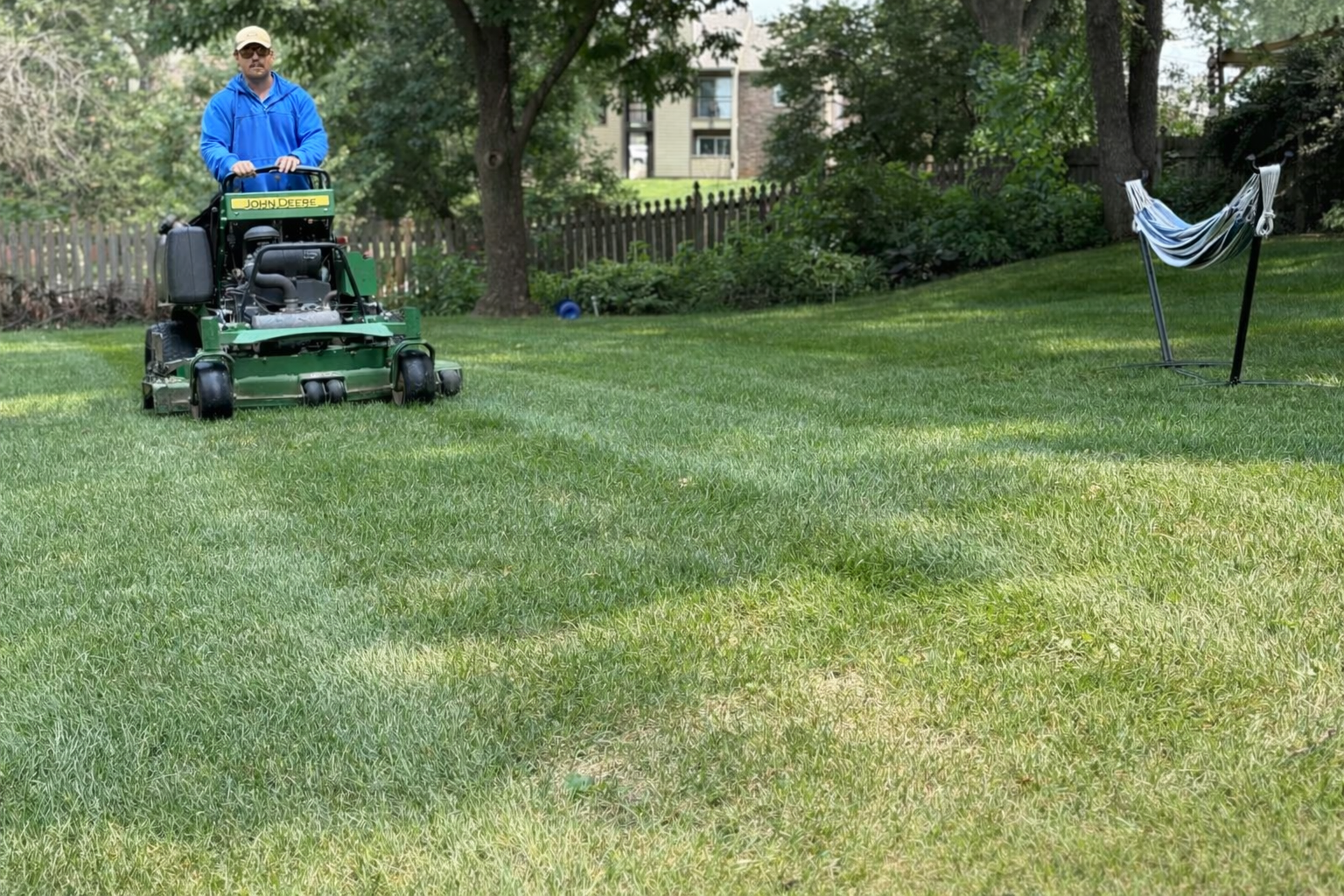
The Best Lawn Care Schedule for Johnson County, KS
A complete month-by-month lawn care calendar for Johnson County, Kansas, covering fertilization, aeration, mowing, overseeding, and seasonal tasks for cool-season lawns.
 Cayden Sommer February 27, 2026 8 min read
 Maintaining a great-looking lawn in Johnson County requires doing the right things at the right time. Our climate in USDA Zone 6a presents unique challenges: harsh winter freezes, unpredictable springs, hot and humid summers, and a narrow window for fall renovation. Miss a key task or do it at the wrong time, and you spend the rest of the year playing catch-up.
This month-by-month schedule is built specifically for the cool-season lawns (tall fescue and Kentucky bluegrass) that dominate properties across Overland Park, Leawood, Lenexa, Olathe, and the surrounding Johnson County communities.
January and February: Planning Season
There isn’t much happening on the lawn itself during the coldest months, but this is the time to prepare.
- Sharpen mower blades and service your mower. A clean-cutting blade is one of the most underrated tools for lawn health.
- Soil test: If you haven’t tested your soil in the past two to three years, order a test kit from the Johnson County K-State Extension office. Results take a couple of weeks and will tell you exactly what amendments your soil needs. Most Johnson County soils trend slightly acidic to neutral with adequate phosphorus but variable potassium levels.
- Plan your approach: Decide whether this is a maintenance year or a renovation year. If your lawn has more than 30-40% weeds or bare spots, you may want to plan a fall overseeding program.
- Avoid foot traffic on frozen or frost-covered turf. Frozen grass blades snap easily, leaving brown footprints that persist for weeks.
March: Early Spring Prep
- Clean up debris: Remove any branches, leaves, or trash that accumulated over winter. This allows sunlight and air to reach the turf as it begins to green up.
- Watch soil temperatures: Growth begins when soil temps reach 45-55 degrees. Check the Kansas Mesonet for Olathe-area readings.
- First mow (late March): Some lawns, particularly south-facing and sunny areas, will be ready for a first mow by late March. Set your height at 3 to 3.5 inches for fescue.
- Hold off on fertilizer: It’s tempting to push growth with an early nitrogen application, but this feeds weed growth as much as grass growth. Wait until the lawn is actively growing.
April: Spring Activation
April is when the growing season truly begins in Johnson County.
- Pre-emergent herbicide: Apply when soil temperatures at four inches hit 55 degrees for three to five consecutive days. This is typically early to mid-April in our area. This prevents crabgrass, foxtail, and other summer annual weeds. Timing is everything here; too late and the weeds have already germinated.
- Begin regular mowing: Weekly mowing starts now. Maintain fescue at 3 to 3.5 inches. Never remove more than one-third of the blade height at once.
- Light spring fertilization: A moderate application of slow-release nitrogen (0.5 to 0.75 pounds of nitrogen per 1,000 square feet) in mid to late April supports spring green-up without pushing excessive top growth.
- Spot-treat broadleaf weeds: Dandelions and clover are actively growing and vulnerable to post-emergent herbicides in April when daytime highs are between 60 and 80 degrees.
May: Peak Spring Growth
- Mow weekly: Growth is at its spring peak. Keep up with weekly mowing and continue mulching clippings.
- Raise mowing height: As temperatures climb, gradually raise your cutting height toward 3.5 to 4 inches. Taller grass shades the soil, reduces water loss, and crowds out weeds.
- Irrigation check: If you have an irrigation system, now is the time to run a startup, check heads, and ensure even coverage. Lawns in Johnson County typically need about 1 to 1.5 inches of water per week from rain or irrigation combined.
- Watch for fungal disease: Spring rains and warming temperatures can trigger leaf spot and other early-season diseases, especially in thick, over-fertilized turf.
June: Transition to Summer
- Continue mowing at 3.5 to 4 inches: This is critical as heat builds. Taller grass develops deeper roots and handles drought stress far better.
- Water deeply and infrequently: Two to three deep waterings per week are better than daily light sprinkles. Aim for about half an inch per session to encourage deep root growth.
- Second fertilizer application (optional): If your lawn looks like it needs a boost, a light application of slow-release fertilizer in early June is acceptable. Avoid fertilizing after mid-June as summer heat approaches.
- Monitor for grubs: Japanese beetle adults begin flying in June. While the grubs don’t cause damage until late summer, preventive grub control (applied in June) is more effective than curative treatment later.
July: Summer Survival Mode
July and August are about keeping your lawn alive, not making it thrive. Cool-season grasses are under significant stress.
- Mow high: 4 inches is not too tall. Resist the urge to cut short for a “clean” look. Height is your lawn’s best defense against heat and drought.
- Reduce mowing frequency: Growth slows dramatically. You may only need to mow every 10 to 14 days.
- Water consistently: If you’re irrigating, keep up the 1 to 1.5 inches per week. If you choose to let the lawn go dormant (it will brown but isn’t dead), commit to dormancy fully. Don’t water sporadically, which triggers growth the lawn can’t sustain.
- No fertilizer: Fertilizing cool-season grass in July is one of the worst things you can do. It pushes top growth when the plant can’t support it and increases disease pressure.
- Watch for brown patch: This fungal disease thrives in hot, humid conditions with nighttime temps above 68 degrees. It’s the most common summer disease in Johnson County fescue lawns.
August: Preparing for Fall
- Late August is transition time: Around the third or fourth week of August, nighttime temperatures begin dropping and cool-season grasses start to perk up.
- Plan fall aeration and overseeding: If you’re planning to aerate and overseed (and you should be most years), schedule it for September. Late August is the time to get on a lawn care company’s schedule before they book up.
- Resume normal mowing: As growth picks back up, return to weekly mowing. Begin lowering your cut height back toward 3 to 3.5 inches gradually.
September: The Most Important Month
If you only invest in your lawn one month out of the year, make it September. This is prime time for cool-season grass renovation in Johnson County.
- Core aeration: Aerate to relieve compaction from summer foot traffic and improve water and nutrient penetration. Early to mid-September is ideal.
- Overseeding: Immediately after aeration, overseed thin or bare areas with quality tall fescue seed. Soil temperatures in the 55-65 degree range are perfect for germination.
- Fall fertilization (round one): Apply 1 pound of nitrogen per 1,000 square feet using a slow-release fertilizer. This is the most important fertilizer application of the entire year. It drives root development and tillering that will carry your lawn through winter and into next spring.
- Continue mowing: Keep mowing at 3 to 3.5 inches. New seedlings will begin emerging in 7 to 14 days after overseeding.
- Water new seed: If you’ve overseeded, keep the top half-inch of soil consistently moist until seedlings are established (about 3 to 4 weeks).
October: Fall Maintenance
- Second fall fertilizer application: Apply another round of fertilizer in mid to late October. This late-season feeding (sometimes called “winterizer”) promotes root storage of carbohydrates that fuel early spring green-up.
- Continue mowing: Growth slows as temperatures drop, but continue mowing as needed.
- Leaf removal: Don’t let fallen leaves smother the lawn. A thick layer of leaves blocks sunlight and traps moisture, creating perfect conditions for snow mold and fungal issues. Remove leaves weekly, or mulch-mow thin layers.
- Post-emergent weed control: October is an excellent time to treat broadleaf weeds like dandelions and henbit. Weeds are actively pulling nutrients into their roots for winter, which means they’ll also pull herbicide down to the root system for a more effective kill.
November: Winding Down
- Final mow: Your last mow of the season should lower the height to about 2.5 to 3 inches. This reduces the risk of snow mold, which thrives under matted, tall grass.
- Complete leaf removal: Get all remaining leaves off the lawn before the first heavy snow. This is non-negotiable for lawn health.
- Winterize irrigation: Blow out your sprinkler system before the first hard freeze, typically mid to late November in our area.
- Clean and store equipment: Drain fuel from mowers or add stabilizer, clean decks, and store equipment properly.
December: Rest
The lawn is dormant. Your main job is to stay off frozen turf and avoid piling heavy snow from driveways and sidewalks onto the same areas repeatedly, which causes compaction.
Our 7-Round Lawn Care Program
Here’s a quick-reference summary of how we structure our professional lawn care program at Sommer Lawn & Landscape:
| Round | Program | Timing |
|---|---|---|
| Round 1 | Fertilizer & Pre-emergent | Done by 1st week of April |
| Round 2 | Spraying Broadleaves | Late May |
| Round 3 & 4 | Summer Fertilizer & Grub | June – Mid July |
| Round 5 | Fall Fertilizer | September |
| Round 6 | Broadleaves | Late September – October |
| Round 7 | Winterizer | Mid October – November |
The Big Picture
The pattern for cool-season lawns in Johnson County is straightforward once you understand it: moderate care in spring, survival mode in summer, and heavy investment in fall. Most homeowners put too much energy into spring and neglect the fall window, which is exactly backward for our grass types and climate.
At Sommer Lawn & Landscape, our lawn care programs are built around this exact calendar, tailored to the local conditions across Johnson County. Whether you want to manage your own lawn or hand it off to professionals who understand the timing, following this schedule will make the biggest difference in how your lawn performs year after year.